
acrylic on illustration board 24" x 18"

Roughly the size and build of a Peregrine, the uncommon and poorly-understood Orange-breasted Falcon (Falco deiroleucus) is distributed patchily in Central and South America. Although it's rarely seen far from heavy tropical forest, it feeds mostly on birds that are captured above the canopy. It nests in nooks in cliffs adjacent to forests, and probably sometimes in tree cavities. The heavy feet and beak of this species are relatively bigger than those of any other falcon. The Granada Morpho (Morpho granadensis) is one of aroud 30 members of a butterfly genus well known for the immense and iridescent blue wings of a number of species. Incidental animals in this painting include a Misfit Leaf Frog (Agalychnis saltator) and a young Fraser's Anole (Anolis fraseri).
PIAPIACS & AFRICAN ELEPHANT
acrylic on illustration board 12" x 24"

Piapiacs (Ptilostomus afer) are small, crow-like corvids that are found in tropical Africa from southern Senegal east to Ethiopia and western Kenya. They forage for insects in small flocks, often perching on the backs of large mammals to hunt the grasshoppers they disturb. Where Piapiacs occur with elephants, they favor them as perches, and unlike oxpeckers, they are tolerated by the pachyderms.
A CIRCLE UNBROKEN--SPOTTED TOWHEE
acrylic on illustration board 30" x 20"

As winter's harshest cold subsides, the Milbert's Tortoiseshell and other bold hibernating insects rouse while the snows deliquesce into life-giving water, soaking the soil and moving nutrients through it, signaling the torpid roots of Glacier Lilies and Short-styled Bluebuells to force their prepunctual greenery through the snow's dingy last remains, to blossom inappropriately on the still wintry forest floor. A brumal blanket pulled back reveals rabbitbrush seeds and other new foodstuffs for scratching towhees. Each year, April holds the promise of new life.
TRIAD--TOKAY GECKO
acrylic on illustration board 20" x 30"

Among the largest of all geckos, the Tokay (Gekko gecko) can reach 20 inches in length. It ranges from Nepal through most of Southeast Asia and the Philippines to western New Guinea, and is well known for its loud nocturnal call (from which the word “gecko” is derived) and willingness to live in close proximity to Humans. Like most geckos, its highly-adapted toe pads allow it to climb easily on most vertical surfaces.
THE PROBLEM OF WILD IDENTITY--RED KANGAROO
acrylic on illustration board 20" x 30"

You can go to Madagascar, Venezuela and Nebraska
Cross the stark Strait of Makassar, trek from Tunis to Timbuktu
You'll see tragopans and troupials, chiropterans and marsupials,
Spend weeks ranking and grouping all variety of snake or shrew
Over a lifetime's exploration fueled by animal admiration
And obsessional observation of feathers, fur and a fang or two
In matters zoological, you can see it's not illogical
To presume some mythological, like the implausible kangaroo.
INDIAN NARROW-HEADED SOFTSHELL & PAINTED STORK (2013)
acrylic on illustration board 24” x 18”

Four genera of huge, mysterious softshell turtles inhabit the Asian continent. On the Indian subcontinent, this group is represented by the endangered Narrow-headed Softshell Turtle (Chitra indica), which haunts slower waters of the Ganges, Godavari, Mahanadi, Satluj and Indus drainages. The shells of these highly aquatic turtles can exceed a meter in length. Their diet consists of fish and aquatic invertebrates along with some plant matter. The females climb onto land to lay their egg clutches, which can contain over one hundred eggs. Although it's poorly known, this turtle is threatened by water pollution and redistribution, and by extensive hunting for its cartilaginous rim or 'calipee,' which is considered a delicacy. The striking Painted Stork (Mycteria leucocephala) enjoys a spotty range, in wet areas over much of Tropical Asia. It is closely related to the American Wood Stork (M. americana). This composition is based on the Khanda, the symbol of Sikhism. Incidental subjects in the painting include the invasive Water Hyacinth (Eichhornia crassipes), Tailed Green Jay Swallowtail (Graphium agammemnon), Twin-banded Loach (Botia rostrata), Zebrafish (Danio rerio), and Skittering Frog (Euphlyctis cyanophlyctis).
SPECTRAL BAT & SMOOTH-BILLED ANIS (2012)
India ink wash on paper 20” x 15”

With a wingspan reaching a yard and a weight approaching half a pound, the Spectral Bat (Vampyrum spectrum) is the New World's largest bat, as well as the largest carnivorous bat and the largest member of the suborder Microchiroptera. It ranges through most of the New World tropics, but is plentiful nowhere. At dusk the bats leave their tree cavity roosts to forage for vertebrate prey, which is located by scent and sound. Among the most common prey items are the three species of ani (Crotophaga spp.), blackish, raggedy-looking cuckoos with odd, puffin-like bills, whose communal roosts are betrayed by the birds' rather strong odor. Unlike typical cuckoos, which are brood parasites, the anis nest in colonies and frequently care for their young communally. Here, a Spectral Bat stalks a group of Smooth-billed Anis (C. ani) through the foliage of a Saragundi (Senna reticulata), a small tree of the mimosa family, to which various medicinal properties are frequently ascribed.
FLORA AND FAUNA OF UPPER NACAPULE CANYON (2012)
acrylic on illustration board 24" x 16"

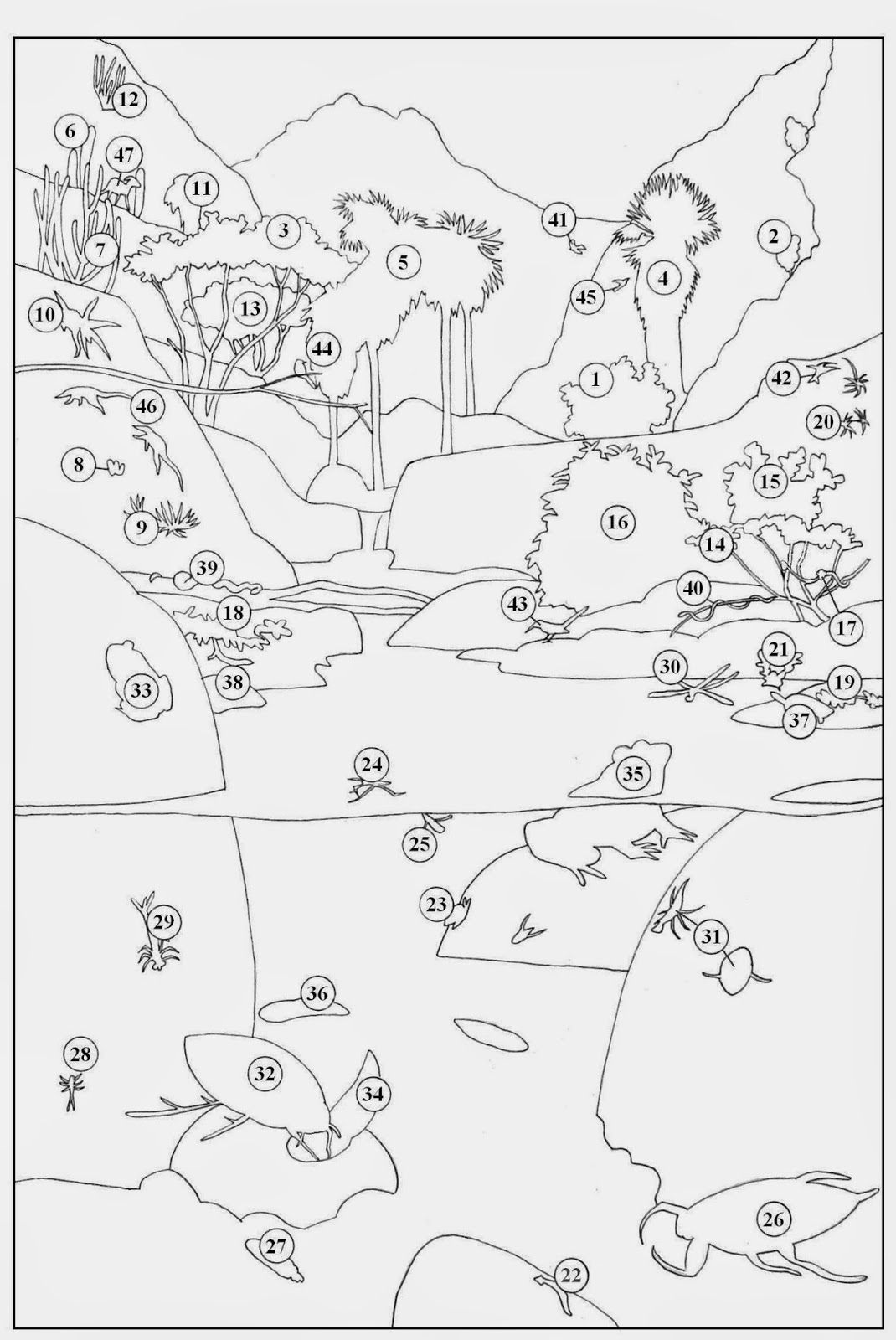
Situated
on the southeastern front of the Sierra El Aguaje, a volcanic
mountain range formed some five million years before the Sea of
Cortez, upon whose eastern flank it now sits, Nacapule Canyon harbors
a unique and diverse ecology, where tropical deciduous scrub forest
transitions into the Sonoran Desert community. It marks the northern
range limit of many tropical species and genera as well as the
southern limit of many Sonoran Desert taxa. The canyon takes its name
from the Nacapule Fig[1] (Ficus pertusa), one of three fig
species in the canyon. The small Rock Fig[2] (Ficus petiolaris)
sprawls up rock faces while the stately Ficus insipidus[3]
grows near the canyon floor, which is dominated by Mexican Fan
Palms[4] (Washingtonia robusta) and the smaller San Jose
Hesper Palm[5] (Brahea brandegeei), which also grows on the
igneous canyon slopes. The flora of the arid, south-facing slope is typical of the Sonoran Desert. It
includes many cacti, including the massive Cardon[6] (Pachycereus
pringlei), the Organpipe Cactus[7] (Stenocereus thurberi),
and the endemic Guaymas Hedgehog Cactus[8] (Echinocereus
engelmannii llanuraensis), two maguey species, Agave
colorata[9] and A. chrysoglossa[10], and such desert trees
as the Palo Blanco[11] (Acacia willardiana), Yellow Palo
Verde[12] (Parkinsonia microphylla) and Desert Ironwood[13]
(Olneya tesota). The flora of the more mesic north-facing
slope is more tropical. It includes the regional endemic shrubs
Zanthoxylum mazatlanum[14], a prickly-ash, Coccoloba
goldmanii[15], a sea-grape, and Vallesia laciniata[16], a
dogbane, and the Mexican Passionflower[17] (Passiflora mexicana).
The spurge family is the most diverse of Nacapule Canyon, with nine
genera and 16 species, including Dalechampia scandens[18] and
the endemic Euphorbia pediculifera linearifolia[19]. Other
interesting Nacapule plants include the Mescalito[20] (Hechtia
montana), a lithophytic bromeliad, and the aquatic Mexican
Primrose-willow[21] (Ludwigia octovalvis). A stream runs
persistently through the upper canyon in all but the driest years,
providing habitat for a rich invertebrate fauna that ranges from
simple worms like flatworms of the family Planariidae[22] and
molluscs like springsnails[23] (Pyrgulopsis sp.) to aquatic
insects like the Water Strider[24] (family Gerridae), the
Backswimmer[25] (family Notonectidae), and the giant water bug[26]
(Lethocerus sp.), aquatic insect larvae of caddisflies[27]
(order Trichoptera) and others, and aquatic naiads of Mayflies[28]
(family Heptageniidae), damselflies[29]--adult[30] (family
Coenagrionidae) and others. Aquatic beetles belonging to at least
three different families can be found in the stream, including the
lovely Sunburst Diving Beetle and its larva[31] (Thermonectus
marmoratus) and the Giant Water Scavenging Beetle[32]
(Hydrophilus triangularis). Amphibians include the Canyon
Treefrog[33] (Hyla arenicolor) and its tadpole[34] and the
Northwest Mexico Leopard Frog[35] (Rana magnaocularis) and its
tadpole[36]. A number of interesting reptile species call the canyon
home, including the Yaqui Slider[37] (Trachemys yaquia), which
is endemic to the region, and isolated populations of the Madrean
Alligator Lizard[38] (Elgaria kingii) and Boa Constrictor[39]
(Boa constrictor), the latter representing the northernmost
extreme of the species' range. Rarely seen is the cryptic Brown Vine
Snake[40] (Oxybelis aeneus). Commonly seen birds of the canyon
include the Red-tailed Hawk[41] (Buteo jamaicensis),
Broad-billed Hummingbird[42] (Cynanthus latirostris), Northern
Mockingbird[43] (Mimus polyglottos), Vermilion Flycatcher[44]
(Pyrocephalus rubinus), and Hooded Oriole[45] (Icterus
cucullatus). Most of Nacapule Canyon's mammal fauna is nocturnal.
Two conspicuous exceptions are the social White-nosed Coati[46]
(Nasua narica), from a tropical genus and the Desert Bighorn
Sheep[47] (Ovis canadensis), from a boreal genus.
ROCK, PAPER, SCISSORS--SIDE-BLOTCHED LIZARDS
acrylic on illustration board 16" x 20"

Through most of the deserts of western North America, the Side-blotched Lizard (Uta stansburiana) outnumbers all other lizard species combined. The males of some populations manifest three different forms: the orange-throats, which are hyper-masculine, the blue-throats, which are moderately masculine, and the hypo-masculine yellow-throats. Each form has an edge over one other form in the competition for breeding. The aggressive orange-throats expend a great deal of energy defending large territories with multiple females, managing to keep most blue-throats out. The blue-throats effectively defend small territories with single females against the yellow-throats, which have no territories, but sneak onto the territories of orange-throats to mate with their females while the male is off chasing blue throats around. Presumably, each form has an overall breeding advantage in different years depending on conditions. It's believed that all modern Side-blotched Lizards are descended from populations that manifested all three forms. The yellow-throated form seems to be the first to disappear from a population. Incidental species in this Sonoran Desert setting include an Elephant Tree (Bursera microphylla), Organpipe Cactus (Stenocereus thurberi), Soaptree Yucca (Yucca elata) and Turkey Vulture (Cathartes aura).
MELLER'S CHAMELEON & HOUSE GECKO (1994)
acrylic on illustration board 20” x 26”
 Meller’s Chameleon (Chamaeleo melleri), at two feet in length is the largest chameleon on mainland Africa. Like the rest of its family, this resident of the savannas of Malawi and Tanzania nails its prey with a well-aimed, sticky projectile tongue. Being of such ample size, it can extend the normal chameleon diet of insects to include such small vertebrates as the Tropical House Gecko (Hemidactylus frenatus), a lizard that has been inadvertently introduced throughout the tropics and subtropics, including Arizona.
APRIL HIBERNACULUM (2011)
acrylic on illustration board 20” x 12”
 Rattlesnakes
survive cold winters by hibernating, usually communally, in small
caverns called hibernacula. Returning to the site in autumn, they spend
more time inside the hibernaculum as the weather gets colder, and
daytime sunning sessions outside of the entrance become less frequent as
they become less effective. The process is reversed in the spring, with
the snakes spending a week or so sleeping in the cavern at night and
basking outside during the warmest hours before finally dispersing.
Until a decade ago, the rattlesnakes of much of the western U.S. were
considered members of a single species, Crotalus viridis. Since then, it's become clear that C. viridis
represented a large complex that taxonomists are still trying to
disentangle. The Great Basin Rattlesnake, which ranges from southeastern
Oregon through most of Nevada, western Utah and southern Idaho, has
gone from a subspecies of C. viridis to a subspecies of C. oreganus, the first species to be split from the group. Today, it's generally given its own species, C. lutusos, which is likely to see further future splitting.
Rattlesnakes
survive cold winters by hibernating, usually communally, in small
caverns called hibernacula. Returning to the site in autumn, they spend
more time inside the hibernaculum as the weather gets colder, and
daytime sunning sessions outside of the entrance become less frequent as
they become less effective. The process is reversed in the spring, with
the snakes spending a week or so sleeping in the cavern at night and
basking outside during the warmest hours before finally dispersing.
Until a decade ago, the rattlesnakes of much of the western U.S. were
considered members of a single species, Crotalus viridis. Since then, it's become clear that C. viridis
represented a large complex that taxonomists are still trying to
disentangle. The Great Basin Rattlesnake, which ranges from southeastern
Oregon through most of Nevada, western Utah and southern Idaho, has
gone from a subspecies of C. viridis to a subspecies of C. oreganus, the first species to be split from the group. Today, it's generally given its own species, C. lutusos, which is likely to see further future splitting.
A TRICK OF THE TAIL--BLUE-CROWNED MOTMOT & LANGSDORFF'S CORALSNAKE
acrylic on illustration board 15" x 20"

Tail-thrashing behavior in
snakes is not limited to rattling. It can be a prelude to battle or
mating, or a means of evading predators. Some fossorial boids like
Calabar Pythons (Charina=Calabaria reinhardtii) and Rubber
Boas (C. bottae) wave their blunt tails about while hiding
their heads. Some elapid snakes, like Langsdorff's Coralsnake
(Micrurus langsdorffii) of the northwest Amazonian Basin,
confuse the enemy by moving both ends simultaneously, in a display
known as self-mimicry. In this painting, the coralsnake's antagonist
is a Blue-crowned
Motmot (
Momotus momota),
a member of a family of inconspicuous but colorful tropical American
forest birds. Except for one uncommon species, they are notable for
their two elongated central tail feathers with a section of
loosely-anchored barbs that quickly fall away, leaving naked shafts
and a characteristic racket-tail. The Blue-crowned is the most
widespread motmot, ranging from Mexico to Trinidad and northern
Argentina. Like the rest of its family, it feeds on some fruits and a
variety of arthropods and small vertebrates, including snakes.
Research has shown that motmots shun the bold black, pale and red
pattern typical of the highly venomous coralsnakes but it has yet to
be determined how they react to the unusual pattern of Langsdorff's
Coralsnake, which lacks black rings. This painting displays a
hypothetical take on this situation. Incidental species include an
unidentified snail of the superfamily Helicoidea, ants of the genera
Allomerus and
Paraponera, a fulgorid
planthopper (Pterodictya reticularis)
and a Long-billed Starthroat (Heliomaster longirostris).
AN ATLANTIC BRACKISH SWAMP
acrylic on illustration board 20” x 15”
 An Eastern Garter Snake (Thamnophis sirtalis sirtalis) disturbs the glassy surface of an Atlantic brackish swamp in an inadvisable advance toward a Common Snapping Turtle (Chelydra serpentina). Incidental subjects include a Blue Crab (Callinectes sapidus), shoreline wolf spider (Pirata sp.), Dragonhunter (Hagenius brevistylus), mosquitos (Culex sp.), Banded Killifish (Fundulus diaphanus) and Belted Kingfisher (Megaceryle alcyon).
CREEKSIDE CONCLAVE--VARIED HARLEQUIN TOADS (2009)
acrylic on illustration board 24” x 18”

During the dry season, over 100 populations of Varied Harlequin Toads (Atelopus varius) once congregated along forest streams in Costa Rica and western Panama to breed. Cloaked in a wide variety of colors and patterns, these beautiful amphibians ranged from cream to lemon yellow, to lime and scarlet, or various combinations of these base hues, splotched or barred with brown, green or black. Ranging in length from one to two inches, the adult males averaged about a quarter smaller than the females. Their gaudiness was probably a case of aposematic, or warning coloring, as their skin contained quantities of the toxic alkaloid tetrodotoxin. In the late 1980s, most populations began a steep decline, beginning in central Costa Rica. The Panamanian frogs didn't start to crash until about 1992. The causes of this crash are not completely understood, but the insidious chytrid fungus Batrachochytrium dendrobatidis played an important role, and is thought to have driven over half the members of the genus Atelopus to extinction in the wild, and been the direct cause of much global frog decline. It is believed that the fungus originated in Africa, and was transported around the world on the skins of African Clawed Frogs (Xenopus laevis), which were widely used for human pregnancy tests as well as other laboratory studies. Wild populations of A. varius were feared extinct, but a small population near Quepos, Costa Rica, discovered in 2003, perseveres. Incidental species in the painting include a leaf-cutter ant (Atta sp.), the butterfly Morpho amathonte, a Cloud-forest Anole (Anolis tropidolepis) and a Blue-gray Tanager (Thraupis episcopus).
EASTERN KINGBIRD & LONG-EARED OWL (2011)
India ink wash & watercolor on paper 22" x 16"<

Long-eared Owls (Asio
otus) nest and roost in heavy woods, which is where we normally
see them, but at night when they're foraging, they are creatures of
open meadows; here in the Rocky Mountains, they frequently hunt in
sage steppes. In this painting I took away the normal button-eyed
expression of the Long-eared Owl and replaced it with one of dismay
and abject annoyance. Eastern Kingbirds (Tyrannus tyrannus)
have a red crown patch that's almost always completely obscured by
black feathers. As kind of a joke, I used a touch of watercolor to
show those red feathers peeking through.
OWLS OF THE USA AND CANADA (2017)
acrylic on panel 18" x 24"

 Family Strigidae: Great Gray Owl [1](Strix nebulosa), Spotted Owl [2] (Strix occidentalis), Barred Owl [3] (Strix varia), Elf Owl [4] (Micrathene whitneyi), Mountain Pygmy Owl [5] (Glaucidium gnoma), Northern Pygmy Owl [6] (Glaucidium californicum), Ridgway's Pygmy Owl [7] (Glaucidium ridgwayi), Northern Hawk Owl [8] (Surnia ulula), Northern Saw-whet Owl [9] (Aegolius acadicus), Boreal Owl [10] (Aegolius funereus), Burrowing Owl [11] (Athene cunicularia), Snowy Owl [12] (Bubo scandiacus), Great Horned Owl [13] (Bubo virginianus), Flammulated Owl [14] (Psiloscops flammeolus), Whiskered Owl [15] (Megascops trichopsis), Western Screech Owl [16] (Megascops kennicottii), Eastern Screech Owl [17] (Megascops asio) Gray morph, Eastern Screech Owl [18] (Megascops asio) Red morph, Long-eared Owl [19] (Asio otus), Short-eared Owl [20] (Asio flammeus) Family Tytonidae: American Barn Owl [21] (Tyto furcata)
OWLS OF THE USA AND CANADA (2017)
acrylic on panel 18" x 24"


